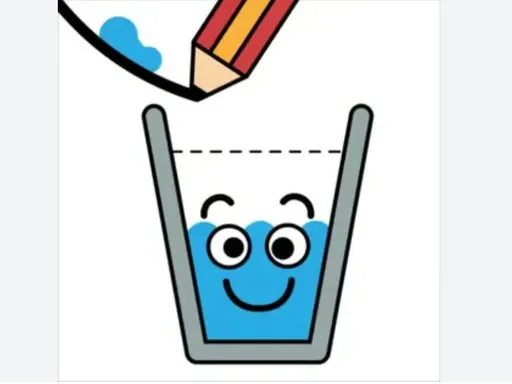
Happy Glass


Rating:
4.26
Played:
13,463
A Puzzle About Water, Space, and Restraint
Happy Glass is a physics drawing puzzle built around a tiny emotional payoff. You start with an empty glass wearing a sad expression, a water source somewhere above it, and a level layout that refuses to cooperate. Your job is to draw a line that guides enough water into the glass to reach the fill mark. When that happens, the face changes and the stage is cleared. The premise is easy to understand in seconds, but the challenge comes from how many small things can go wrong along the way.
The game works because it turns simple inputs into meaningful decisions. A short line can become a ramp, a wall, a bridge, or a shield. The angle of that line changes how droplets bounce, how quickly they fall, and whether they settle safely inside the glass or spill across the stage. Because the levels are compact and restarts are immediate, you spend very little time waiting and a lot of time testing ideas. That fast loop makes even failed attempts feel useful.
Happy Glass also rewards efficiency. Many versions score your solution by how little ink you use and how cleanly you complete the objective, so a bulky drawing may work while a precise one usually teaches more.
How a Typical Level Unfolds
Most levels begin with the same question: where should the first drop go? Sometimes the glass is directly below the faucet but separated by a ledge. Sometimes it sits at an awkward angle, which means water can enter but immediately splash out again. In harder stages, moving platforms, floating shapes, or awkward gaps force you to think about timing as well as direction. The water follows gravity, so the puzzle is less about brute force and more about reading the shape of the space before you draw.
That is why the best first move is usually observation. Look at the faucet, the rim of the glass, and any surfaces that can naturally redirect the stream. Ask whether you need a long path or just one small correction near the top. In Happy Glass, overbuilding is one of the most common beginner mistakes. Large drawings can block the opening, trap water in the wrong pocket, or create sharp corners that spray droplets out of bounds.
As the stage list progresses, the game gives you less room to work and more reasons to stay disciplined. The puzzle design stays approachable, but it steadily teaches momentum, spill risk, and the difference between a line that guides water and a line that fights it.
Play Happy Glass in Your Browser
Happy Glass fits browser play especially well because each stage is short, self-contained, and easy to restart. You do not need a long setup period to enjoy it. If you want to jump in quickly, you can play Happy Glass online and start drawing right away.
On desktop, the game feels most precise with a mouse because you can place narrow ramps and protective edges carefully. On a phone or tablet, touch controls feel natural too, since the core action is sketching with your finger. That cross-device simplicity is a big part of the appeal.
Browser play also makes experimentation easier. You can retry a stage, shorten a line, change the curve, and immediately see whether the water behaves better. The fun comes from learning the physics one small discovery at a time.
Controls, Scoring, and Mistakes to Avoid
Basic controls
On desktop, click and drag to draw a line. On touch devices, tap and drag with one finger. Many versions also include a restart button so you can reset the puzzle instantly after a failed attempt. The controls are minimal by design, which keeps the focus on planning and execution rather than on managing a lot of inputs.
How to earn better results
Happy Glass often rewards solutions that use less ink, waste less water, and clear the level cleanly. Once you understand a stage, reduce the size of your drawing, smooth out an unnecessary angle, or reposition the line so the stream enters the glass more directly.
Practical habits that improve consistency
Start with the simplest possible line and only add complexity if the level proves you need it. Leave room above the rim so the water can land instead of colliding with a barrier. Use sloped shapes instead of jagged ones whenever you want a smooth flow. If a level includes obstacles, decide whether they should help redirect the stream or whether you need to neutralize them with a wall. Most importantly, pay attention to where the first part of the stream goes, because early mistakes usually decide the whole attempt.
The most common failures are easy to recognize. Players draw too close to the cup and cause splashing, build a giant support that traps water, or ignore the angle of entry and let the stream hit the outer rim instead of the opening.
From Mobile Hit to Browser Staple
Happy Glass is widely associated with Lion Studios, and current mobile store listings still present it as a puzzle title from that publisher. Release records and storefront archives point back to a 2018 mobile launch, which helps explain why the game feels designed for instant understanding and short repeat sessions.
That origin still shows in the browser version. The goal is obvious at a glance, the emotional feedback is immediate, and the level structure encourages constant retrying without friction. It relies on a clean feedback loop: observe the layout, draw a solution, watch the result, and refine the next attempt.
That design is a major reason Happy Glass has lasted. It is friendly enough for new players, but it also gives thoughtful players room to optimize and revisit levels with cleaner routes.
FAQ
Is Happy Glass free to play online?
Yes. Browser versions are typically free to start, so you can load a level and begin drawing without installing extra software.
What kind of puzzle is Happy Glass?
It is a physics drawing puzzle. You create lines that redirect falling water so it reaches the glass and fills it to the target level.
Can I play Happy Glass on mobile?
Yes. The game works well on phones and tablets because the main action is drawing with a finger, which feels direct and intuitive.
Why do easy-looking levels still fail?
Small angle mistakes matter a lot. A line that is only slightly too steep or too close to the rim can cause the water to bounce, spill, or collect in the wrong place.
How do I get better scores?
Focus on simpler drawings, cleaner water flow, and fewer wasted strokes. Once you can solve a stage reliably, refine the shape until it uses less ink and wastes less water.
Should I draw near the glass or near the faucet?
It depends on the layout, but adjusting the stream near the faucet is often safer because it influences the whole path early and reduces messy corrections near the rim.
Does Happy Glass require fast reactions?
Not usually. Most levels reward observation and controlled planning more than speed, which is why the game feels relaxing even when the puzzles become tricky.




Comments
Loading comments…